by Richard Schutte
Do we still need Architects and Builders in the Age of AI and Modern Methods of Construction (MMC)?
As AI-driven “vibecoding” challenges the traditional role of the software developer, the value of expertise and diversified experience has only intensified to distinguish quality work from AI “slop”. The same is true for the AEC industry, where advances in AI and MMC are creating opportunities for technology and the built environment to become more intertwined in new ways, bringing quality and cost predictability to a higher level of certainty. While these tools can be helpful, they are also risky; Architects and Builders are needed more than ever. The following sections describe how Assembly is preparing for this future.
Transitioning from Project Thinking to Product Thinking
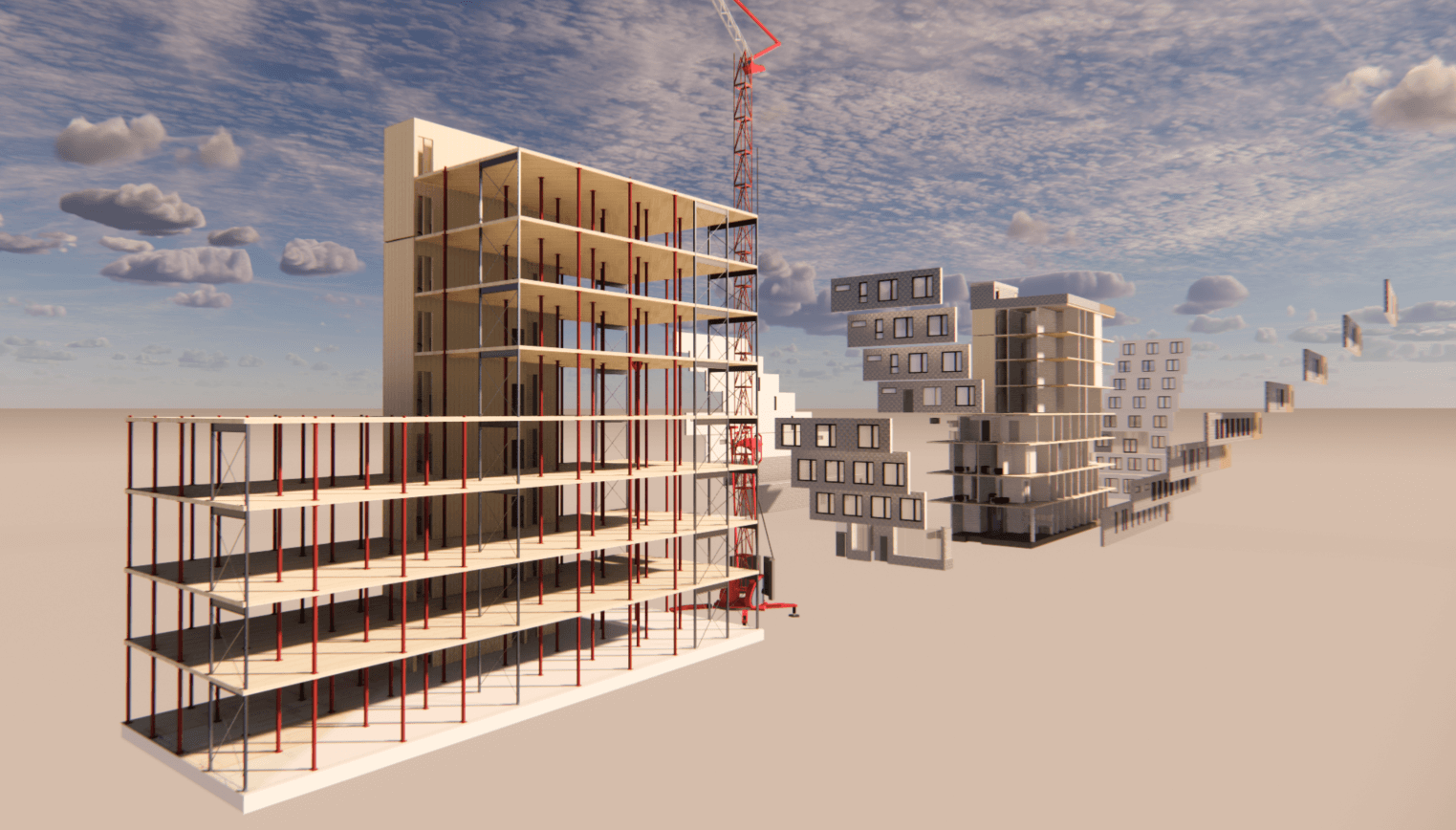
To meet the national target of 500,000 homes per year, we must shift the bulk of construction to a controlled factory environment to reduce timelines by up to 50% (CICC, 2025, 11.) Assembly Corp. is moving beyond traditional construction by adopting a Configure-to-Order (CTO) approach in our product development to increase repeatability without excessively hindering buildable area or site-specific requirements. Unlike a bespoke Engineer-to-Order (ETO) process or a static Select-to-Order (STO) catalogue, our “Kit-of-Parts” strategy allows us to configure buildings from a library of pre-coordinated components. This ensures that Design for Manufacturing and Assembly (DfMA) is integrated from day one without overconstraining the design. This product development approach demands deep integration between Architects, Engineers, and Builders.
Bridging Parametric Logic and Augmenting Revit Databases
While Revit remains the crucial modelling standard, its interface and architecture are outdated. To interact effectively with this BIM database, we’ve implemented Generative DfMA in our building configurator, which connects parametric Grasshopper3D logic directly to our Kit-of-Parts in Revit via Rhino.Inside. This tool has greatly accelerated feasibility studies, BIM modelling and management, and given our Design Team the time and insight to effectively iterate and improve our projects.
Recently, we’ve also introduced Claude MCP (Model Context Protocol), which serves as a “BIM Accelerator.” Claude acts like a team of programming assistants that generate code on the fly, bridging the gap between parametric logic and murky BIM tasks. This enables us to:
- Embed Code Logic: Hardcode complex aspects of the building code, such as zoning constraints, accessibility, egress requirements, and soon limiting distances, directly into the parametric ruleset. Design dealbreakers are now inputs to drive pre-validated and pre-coordinated design.
- Refine Sustainability: Refine Sustainability: Navigate the nuances among the cost, carbon, and schedule impacts of structural materials like concrete, Mass Timber, and Light Wood Frame (LWF) that have been used prototypically and experimentally across Assembly’s projects. While mass timber excels at carbon sequestration, more wood is not inherently more sustainable; we use a hybrid approach with LWF wall panels and load-bearing LWF structure on smaller buildings to balance material volume against embodied carbon while accounting for manufacturing waste.
- Resolve the 80/20 Split: Distill 80% of a project into manageable, automated procedures, while reserving manual Modify-to-Order (MTO) workflows for the unique 20% of site-specific challenges, such as unique ground floor programming.
Integrated Systems and a Collective Learning Database
A systems-oriented approach ensures that research and unnecessary project expenses only happen once. In constantly feeding learning and external expertise into a product development and project implementation plan, problems can be flagged before they become problems. Engaging consultants earlier, working towards a repeatable solution, is an investment that pays for itself many times over through reduced change orders, accelerated entitlements, and accurate early-stage cost and schedule. The hidden gold of this collective learning is found when AI is used by various members of a team to quickly reference large databases like the Ontario Building Code or client design requirements with tools like NotebookLM, and when project data and retrospective learnings become a living database to be referenced or appended by LLM’s like Claude or Gemini.
Ultimately, AI is not here to take jobs from Architects or Builders, especially those brave enough to test these new tools. Disparate information across industries is becoming democratized and made available to anyone who dares to test an idea. By combining confidence with a risk-averse, process-driven workflow, we can eliminate repetitive tasks and unlock the true value of prefabrication and build affordable, accessible homes that Canada needs.
This upcoming Hackathon will use this collective intelligence to explore parametric and AI-assisted workflows to augment Revit as a BIM database and encode a scalable, high-performance delivery system.